
SEE MORE:
Zodiac Signs That Struggle to Make Decisions Alone
Smart Money Tips for Zodiac Signs That Struggle to Save
3 Zodiacs That Struggle With The First Date
Not because they love less — but because the very qualities that make them extraordinary also make them genuinely, specifically difficult to love and to be loved by.
Introduction: Why Relationship Struggle Is Not a Verdict on Worth
Some signs of the zodiac move through relationships with a relative ease that other signs watch from a distance with a mixture of admiration and private envy. For some signs, the rhythms of partnership come naturally — the give and take, the negotiation of needs, the sustained, daily presence and attentiveness that genuine intimacy requires feel like extensions of their most innate qualities rather than demanding disciplines that must be consciously practiced. And then there are the signs for whom relationship is a perpetual stretching — a realm in which their most characteristic qualities create friction that their most sincere intentions cannot always smooth, in which the distance between how they love and how they are able to be loved sometimes feels wider than they would like to admit.
This article is about those signs — the ones for whom relationship has never quite been the natural, effortless territory that popular culture suggests it should be. It is not an indictment of these signs. The struggles described here are not the product of insufficient love or inadequate character. They are the specific, predictable consequences of each sign’s most defining qualities meeting the inherently demanding requirements of genuine intimate partnership — the requirements of sustained presence, genuine vulnerability, honest communication, and the willingness to be both known and changed by another person over the extended, imperfect, genuinely complex arc of a real relationship.
Every quality that creates struggle in relationship is also, viewed from a different angle, a genuine strength. The Scorpio whose trust issues create relational friction is the same Scorpio whose depth of loyalty and passionate devotion make them, when the trust is present, among the most extraordinary partners imaginable. The Aquarius whose emotional unavailability frustrates partners is the same Aquarius whose brilliant, visionary, genuinely inspiring mind can make a partner feel like they are living inside the most interesting life on the planet. The struggle is the shadow of the gift. Understanding the shadow is the first step toward integrating it.
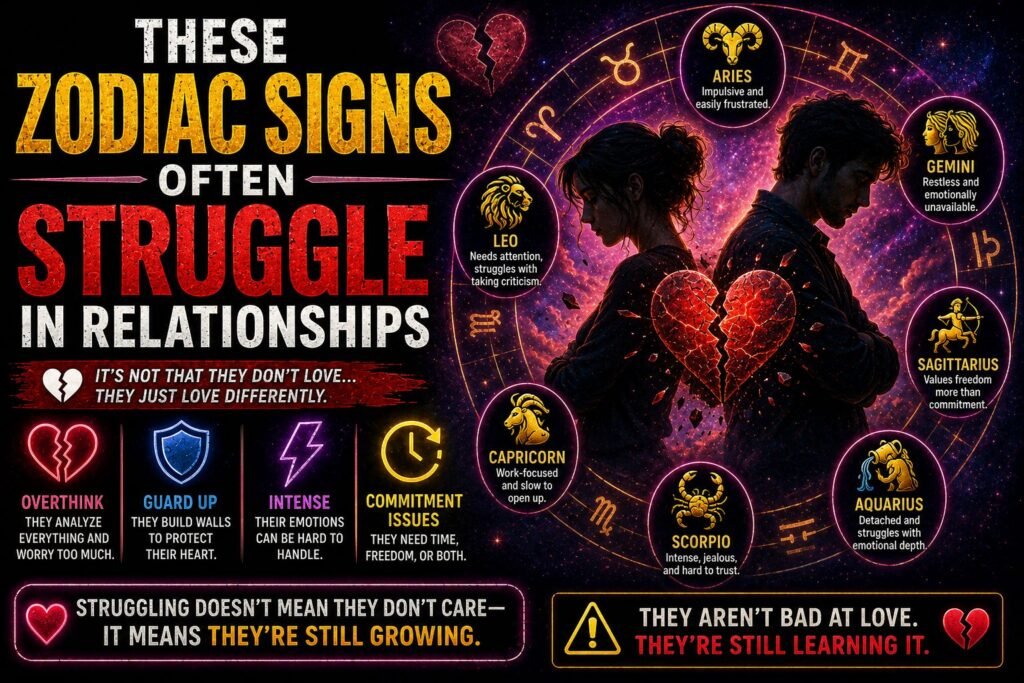
The signs featured in this article as the most consistent relationship strugglers are Aries, Scorpio, Aquarius, Gemini, Sagittarius, and Capricorn. Each struggles in a distinct and specific way — not because they share a common deficiency, but because the specific constellation of their qualities, needs, and fears creates specific, recognizable patterns of relational difficulty that appear with enough consistency across their relationships to be genuinely worth examining. For each sign, the struggle is named honestly, its roots are explored with compassion, and the specific path toward greater relational ease is offered with the pragmatic directness that real growth always requires.
Why Relationships Are Genuinely Hard — For Everyone
Before examining the specific struggles of each sign, it is worth grounding the conversation in the honest acknowledgment that relationships are genuinely, structurally difficult — not because people are flawed, but because what genuine intimacy requires is among the most demanding things any human being can undertake. To be in a real relationship is to allow another person’s needs, moods, rhythms, and priorities to regularly intersect with and sometimes override your own. It is to be seen on your worst days as well as your best. It is to maintain genuine care and genuine respect for someone at the moments when they are least easy to care for or respect. It is to grow, not in a direction of your choosing and at your preferred pace, but in the direction that the specific, irreducible reality of this specific other person requires.
Every sign struggles with some aspect of this. The signs featured in this article simply struggle with specific aspects of it more consistently, more visibly, and with patterns that are specific enough to be genuinely predictable from the sign alone. Understanding those patterns — in yourself or in someone you love — is not a reason for resignation. It is the beginning of the work that makes the relationship possible.
The Role of the Shadow
In Jungian psychology, the shadow is the collection of qualities, impulses, and ways of being that a person finds most difficult to acknowledge in themselves — the aspects of their nature that have been disowned, suppressed, or projected onto others because they conflict with the self-concept or with the demands of the social environment. In astrology, each sign has a characteristic shadow — the specific dimension of their nature that creates the most relational difficulty not because it is the worst part of them, but because it is the most unconsciously active part. The Scorpio’s shadow is control. The Aquarius’s shadow is emotional unavailability. The Gemini’s shadow is inconsistency. These shadows do not disappear when they are named — but they lose much of their unconscious power over relational behavior when they are honestly acknowledged and consciously worked with. That is the purpose of what follows.

♈ Aries | March 21 – April 19
Core Struggle: Putting themselves first — reflexively, and sometimes at the direct cost of the relationship’s health.
Aries: The Ram Who Charges Alone
Aries is the first sign of the zodiac, and this primacy is not merely symbolic — it reflects a fundamental orientation toward the self, toward individual initiative, and toward the primacy of personal desire and momentum that is both Aries’s greatest professional asset and their most consistent relational challenge. In the domain of intimate partnership, the qualities that make Aries extraordinary — the boldness, the self-direction, the willingness to pursue what they want without excessive consultation or deference — create a dynamic in which partners can feel chronically sidelined, as if they are supporting characters in the Aries story rather than co-authors of a shared one.
The specific forms this takes in relationships are varied but recognizable. Decisions made unilaterally before the partner has been meaningfully consulted. Plans that assume the partner’s agreement rather than seeking it. The emotional needs of the Aries taking precedence over the emotional needs of the partner not through malice but through the simple, reflexive logic of a sign whose primary relational instinct is forward motion rather than lateral consideration. The partner of a self-absorbed Aries rarely doubts that they are loved — the love is genuine and often lavishly expressed. What they doubt is whether they are genuinely taken into account when it matters.
The deeper issue beneath Aries’s relational self-centeredness is a genuine developmental one: the capacity for genuine mutual consideration, for the patient, sustained attention to another person’s inner world that partnership requires, is a skill that Aries’s nature does not automatically generate. It must be consciously developed — practiced deliberately, as a discipline, in the same way that a naturally impatient person learns patience not by becoming someone different but by repeatedly choosing the behavior that does not come naturally until it gradually becomes more instinctive.
The Path Forward: Practice the pause before the decision. Before acting on any impulse that affects the partner, stop and ask: ‘Have I genuinely considered how this affects them?’ Not perfunctorily — genuinely. The Ram who learns to pause becomes, paradoxically, a more powerful and more beloved partner.
♏ Scorpio | October 23 – November 21
Core Struggle: The combination of intense possessiveness and deep mistrust — wanting total intimacy while fearing total vulnerability.
Scorpio: The Paradox of Desperately Wanting What They Cannot Fully Allow
Scorpio’s relationship struggle is among the most poignant in the zodiac because it is rooted not in indifference to love but in an almost overwhelming desire for it — combined with a set of deeply ingrained protective mechanisms that make the genuine vulnerability that deep love requires genuinely difficult to sustain. Scorpio wants, more than most signs, the kind of total, soul-level intimacy that dissolves the distance between two people and creates something genuinely shared between them. And Scorpio, more than most signs, has the depth, the passion, and the capacity for devotion that such intimacy requires. The problem is the fear — the pervasive, historically rooted, and for many Scorpios completely understandable fear of betrayal, of being used against themselves, of giving access to the deepest parts of their being and having that access weaponized.
The fear produces a specific relational dynamic: Scorpio demands complete openness and transparency from their partner while maintaining strategic opacity about their own inner life. They want to know everything — about where the partner has been, who they have spoken to, what they are feeling, what they are thinking — while sharing themselves in carefully measured, controlled portions. The partner experiences this asymmetry as profoundly unfair, as a form of relational surveillance that is simultaneously invasive and withholding. And they are right. But the Scorpio who operates this way is not doing so out of calculated unfairness — they are doing so out of a terror of vulnerability that feels, from the inside, completely reasonable given the history that produced it.
The possessiveness that accompanies this dynamic is equally rooted in fear rather than in any genuine desire to control — it is the possessiveness of someone who has been hurt by loss and who is trying to ensure, through vigilance and preemptive management, that the loss does not happen again. It cannot work, and on some level Scorpio knows it cannot work — which creates a layer of anxiety beneath the possessiveness that makes the whole dynamic even more exhausting for both parties. The genuine solution is not the suppression of the fear but its honest acknowledgment — to the partner and to themselves — combined with the deliberate, courageous decision to extend trust before it has been proven rather than demanding it be proven before it is extended.
The Path Forward: Tell the partner about the fear rather than acting it out through surveillance. ‘I am struggling with trust because of what happened before’ is a vulnerable, connecting sentence. ‘Why haven’t you texted back?’ is a control mechanism. One builds intimacy. The other erodes it.
♒ Aquarius | January 20 – February 18
Core Struggle: Emotional unavailability — genuinely present intellectually, genuinely absent emotionally, and often unaware of the difference.
Aquarius: The Mind That Is Always There and the Heart That Is Rarely Home
Aquarius’s relationship struggle is, in some ways, the most invisible of the struggles in this article — because from the outside, and often from Aquarius’s own perspective, the relationship appears to be functioning well. The conversations are extraordinary. The intellectual engagement is genuine. The broad-spectrum care and concern for the partner’s wellbeing is real. Aquarius shows up to the relationship with extraordinary cognitive presence: they are interested, they are thoughtful, they are capable of genuinely brilliant insight into the partner’s situation and genuinely useful perspective on the partner’s problems. What they are less reliably present for is the emotional dimension — the simple, embodied, non-analytical experience of being with the partner in their feelings rather than thinking about the partner’s feelings from a comfortable intellectual distance.
Partners of Aquarius often describe the same experience: they feel intellectually known and emotionally lonely simultaneously. The conversations are the best they have had with anyone. The comfort of being emotionally held — of being with someone who can simply receive their feelings without immediately analyzing them, contextualizing them, or solving them — is elusive. Aquarius’s emotional unavailability is not a choice, not a deliberate withholding, and not evidence of insufficient love. It is the natural expression of a sign whose consciousness is primarily oriented toward the conceptual rather than the sensorial — whose natural habitat is the realm of ideas and whose emotional life, while real and sometimes surprisingly deep, is less automatically accessible than the intellectual life.
The developmental challenge for Aquarius in relationship is the cultivation of emotional presence — the specific skill of setting aside the analytical, problem-solving, intellectualizing orientation when the partner needs not a solution but simply a witness. This is genuinely difficult for Aquarius because the intellectual orientation is not a habit they can simply put down — it is a fundamental quality of how they process reality. But with genuine motivation and deliberate practice, Aquarius can learn to be as present to their partner’s emotional experience as they naturally are to their partner’s intellectual life. And the relationship that becomes available to an emotionally present Aquarius is qualitatively different from anything their characteristic intellectual engagement alone can produce.
The Path Forward: When a partner is upset, resist the urge to analyze, explain, or solve for 10 minutes. Simply be present. Ask: ‘How does that feel?’ and then listen to the answer without comment. This single practice, repeated consistently, changes the relational landscape for Aquarius more than any intellectual understanding of it ever could.

♊ Gemini | May 21 – June 20
Core Struggle: Chronic inconsistency — the gap between the captivating connection they create and the sustained presence they struggle to maintain.
Gemini: The Most Fascinating Partner Who Is Never Quite Fully There
Gemini’s relationship struggle is built into the very quality that makes them most irresistible at the start of a connection: the mercurial, multi-faceted, perpetually interesting nature that makes every conversation feel like an adventure and every moment in their company feel charged with possibility. The shadow of this quality is a difficulty with the sustained, sometimes monotonous, occasionally difficult work of being consistently, reliably present in a single relationship over the extended arc of genuine partnership. Gemini is extraordinary at the beginning. They are less reliably extraordinary at the middle — the long, unglamorous, deeply important middle where most of the actual relationship is lived.
The inconsistency takes multiple forms. Emotional inconsistency: the partner who experienced total warmth and engagement last week encounters inexplicable distance this week, with no explanation and sometimes no awareness on Gemini’s part that the shift has occurred. Communicative inconsistency: the responsiveness and attentiveness that characterized the early stages gives way to periods of distraction and unavailability that the partner experiences as withdrawal. And commitment inconsistency: the declarations made in moments of genuine enthusiasm that are not quite honored when the enthusiasm settles, not because Gemini is dishonest but because the self that made the declaration and the self that must honor it feel, to Gemini, genuinely different from each other.
This last point touches the deepest root of Gemini’s relational difficulty: the experience of a genuinely plural selfhood — of being, authentically and simultaneously, multiple different people with different needs, different moods, and different orientations toward the relationship — that makes sustained consistency feel not like a choice but like an impossibility. Partners experience this plurality as unreliability. Gemini experiences it as authenticity. Both are, in their own terms, correct. The work is the development of a meta-consistency — a consistent commitment to the relationship itself that holds regardless of which face of the Gemini multiplicity is present on any given day.
The Path Forward: Develop the practice of naming the internal weather to the partner before it creates relational weather. ‘I’m feeling inward today and may seem distant — it’s nothing about you’ is infinitely more connective than simply going distant without explanation. Communication is Gemini’s greatest gift. Use it on the relationship, not just in it
♐ Sagittarius | November 22 – December 21
Core Struggle: Fear of being truly committed — the flight response that activates precisely when love becomes real enough to require genuine sacrifice of freedom.
Sagittarius: The One Who Is Always Almost Ready to Stay
Sagittarius’s relationship struggle is one of the most painful in this article — both for the Sagittarius who experiences it and for the partners who love them — because it is not a struggle with love itself. Sagittarius is capable of genuine, enthusiastic, warmly expressed love. The struggle is specifically with the particular quality of love that sustained partnership requires: the love that stays not because everything is exciting and nothing is difficult but because the commitment is real and the person is worth staying for even when staying requires sacrifice.
The flight response that characterizes Sagittarius’s most significant relational difficulty is not cowardice — Sagittarius is among the bravest signs in the zodiac in virtually every other domain of life. It is a specific form of the freedom drive that runs so deep in the Archer’s nature that the genuine constraints of intimate partnership — the accountability, the consideration, the willingness to have one’s horizons shaped by another person’s presence in their life — register, at a pre-rational level, as threats to something essential about who they are. The response to this threat is not necessarily a literal departure. It is sometimes a psychological one: the gradual withdrawal of full presence, the increasing emphasis on personal projects and adventures and social connections at the expense of the relational one, the subtle but unmistakable message to the partner that Sagittarius is here but not quite, committed but not fully.
The partners of commitment-averse Sagittarians experience a specific and particularly frustrating form of relational insecurity: the uncertainty of never quite knowing where they stand, of loving someone who is clearly present but somehow perpetually on the verge of leaving — whose physical presence is accompanied by an emotional one-foot-out-the-door quality that makes genuine relational safety impossible. The Sagittarius who wants to change this pattern — and many, privately, deeply do — must confront the specific fear beneath the flight: the fear that committing completely means becoming less than they are. The truth, which the wisest Sagittarius eventually discovers, is the opposite: genuine commitment to the right person does not diminish freedom. It creates the specific, deeply satisfying freedom that only comes from having genuinely chosen something and standing by the choice.
The Path Forward: Notice the flight impulse before acting on it. When the urge to create distance arrives, ask: ‘Am I pulling back because something is genuinely wrong, or because something is getting real?’ These are very different situations requiring very different responses. The second one deserves presence, not retreat.
♑ Capricorn | December 22 – January 19
Core Struggle: The work-life imbalance that leaves partners feeling like secondary priorities in a life organized around professional achievement.
Capricorn: The Partner Who Is Always Slightly Elsewhere
Capricorn’s relationship struggle is among the most practically consequential in this article because it is so deeply embedded in the structure of their daily life rather than simply in their psychological patterns. The professional orientation that makes Capricorn one of the most impressive and most accomplished signs in the zodiac — the single-minded dedication to their goals, the willingness to invest whatever time and energy achievement requires, the long-term thinking that constantly prioritizes the future over the present — creates, in the context of an intimate relationship, a chronic experience of emotional and practical unavailability that partners find, over time, genuinely difficult to sustain.
The partner of a work-absorbed Capricorn often describes a specific kind of relational loneliness: the loneliness of sharing a life with someone who is highly successful, deeply respected, and unmistakably devoted to their professional objectives, while experiencing the personal relationship as something that receives Capricorn’s attention primarily in the margins — the time left over after the work is done, which is often very little time, and often time in which Capricorn is too depleted by the day’s professional demands to be genuinely present for the relationship’s emotional needs. The relationship functions. It may even appear, from the outside, to be flourishing. What is missing is the quality of presence — the unglamorous, non-optimized, simply being-there quality of attention that makes a partner feel like they matter as much as the achievement.
The deeper issue for Capricorn is the fear of vulnerability disguised as professional devotion. Work is safe — it responds predictably to effort, it produces visible, measurable results, it provides an unambiguous sense of worth and accomplishment that the messier, less controllable domain of intimate relationship does not reliably deliver. By staying primarily in the professional domain, Capricorn protects themselves from the specific vulnerability of a relationship that might not succeed, of a partner who might leave, of an emotional investment that produces no guarantee of return. The work is the castle. The relationship is the territory left inadequately defended.
The Capricorn who wants to genuinely change this pattern — who recognizes that the relational cost of their professional priority is real and significant — must be willing to do something genuinely difficult: to treat the relationship with the same level of strategic intentionality they bring to their professional goals. Not to optimize it — love cannot be optimized — but to prioritize it deliberately, to protect time for it with the same discipline they protect professional time, and to bring to the question of how to be a genuinely present partner the same quality of focused attention they bring to the question of how to succeed at work.
The Path Forward: Create a relational commitment that is treated with the same non-negotiable seriousness as a professional one. One protected evening per week, phone away, fully present. Not as a romantic gesture — as a structural decision. Capricorn keeps structural decisions. Keep this one.
What All Six Struggles Have in Common
Examined together, the relationship struggles of Aries, Scorpio, Aquarius, Gemini, Sagittarius, and Capricorn reveal a common architecture that is worth naming directly: every struggle in this article is rooted in a fear, and every fear is rooted in a genuine wound. Aries’s self-centeredness is the fear of being subsumed — of losing the individual momentum and self-direction that is the core of their identity. Scorpio’s possessiveness and mistrust is the fear of betrayal. Aquarius’s emotional unavailability is the fear of engulfment — of the personal emotional life becoming so consuming that the clarity and independence of the intellectual life is lost. Gemini’s inconsistency is the fear of being trapped by a single commitment. Sagittarius’s flight response is the fear that commitment means the end of freedom. Capricorn’s professional priority is the fear of the vulnerability that genuine relational investment requires.
These fears are not weaknesses to be ashamed of. They are, in every case, the predictable product of specific experiences — early relational experiences, cultural influences, and the particular constellation of each sign’s evolutionary challenges — that have shaped the way they approach intimacy. Understanding the fear behind the struggle transforms the struggle from a character flaw into a development edge: a specific area of growth that, when engaged with honestly and consistently, produces not just better relationships but a more integrated, more genuinely capable version of the person doing the work.
The Role of the Partner in These Dynamics
It would be incomplete and somewhat unfair to discuss the relationship struggles of these six signs without acknowledging the role that partners play in the dynamics described. Every relational pattern is a system — a co-created dynamic that involves the contributions, conscious and unconscious, of both parties. The Scorpio’s possessiveness is more pronounced with a partner who is secretive. The Aquarius’s emotional unavailability is more problematic with a partner who has strong emotional needs and limited tolerance for intellectual engagement. The Sagittarius’s flight response is more activated by a partner who clings.
This is not to say that the partner is responsible for the struggling sign’s patterns — they are not. But it is to say that the most effective work on any of these relational struggles takes place in relationship rather than in isolation, requires the honest participation of both people rather than the one-sided improvement of one, and is most productively undertaken in the context of genuine mutual understanding rather than the assignment of blame and the expectation of unilateral change. If you are the partner of one of these signs, your most useful contribution is not the management of their struggle but the honest, compassionate naming of how it affects you — combined with the genuine curiosity about what is beneath it that makes understanding possible.
Growth Is Always Possible
The most important thing to say about every struggle described in this article is this: it is not fixed. The patterns described here are not permanent features of each sign’s relational destiny. They are the current expression of specific fears, operating in the specific way that those fears have learned to express themselves in the domain of intimate partnership. And fears, when met with genuine honesty, genuine compassion, and the willingness to repeatedly choose the behavior that does not come naturally in service of the relationship that genuinely matters — fears change. They do not disappear. But they lose their automatic, unconscious control over the behavior. And in that space between the fear and the response, genuine relational growth becomes not just possible but available to anyone willing to do the work.
Closing Reflections: The Struggle Is Not the Sentence
Every sign in this article struggles in relationship not because they are incapable of love — they are deeply, genuinely capable of it — but because the specific qualities that make them extraordinary in other domains of life create specific, predictable friction in the domain of intimate partnership. Aries’s boldness creates self-centeredness in love. Scorpio’s depth creates possessiveness. Aquarius’s brilliance creates emotional distance. Gemini’s versatility creates inconsistency. Sagittarius’s expansiveness creates the flight response. Capricorn’s achievement orientation creates emotional unavailability. In every case, the struggle is the shadow of the gift.
The path through these struggles is not the suppression of the gift — not the Aries becoming less bold, the Scorpio becoming less deep, the Aquarius becoming less brilliant, or any of the others becoming less of what makes them who they genuinely are. It is the integration of the gift with its shadow: the development of the specific relational capacities that the gift’s shadow is currently obscuring. Aries developing consideration alongside boldness. Scorpio developing trust alongside depth. Aquarius developing emotional presence alongside intellectual brilliance. Gemini developing relational consistency alongside versatility. Sagittarius developing commitment alongside expansiveness. Capricorn developing vulnerable presence alongside achievement.
This integration is not a project with a completion date. It is the work of a relational lifetime — the ongoing, imperfect, deeply worthwhile project of becoming someone who can be genuinely intimate with another person while remaining genuinely themselves. Every step in this direction, however small, however imperfect, however different from the destination it is clearly not yet, makes the relationship better and the person doing the work more whole.
The struggle is not the sentence. It is the invitation. And every sign in this article — every person who recognizes their own pattern in these pages and feels the particular combination of recognition and motivation that genuine self-knowledge always produces — is exactly the right person to accept it.
~ The relationship that is worth having is always the one that asks us to become more than we have yet been willing to be. ~